
Understanding the
Public School System
Navigating the public school system can feel overwhelming, but understanding how it works and the roles of everyone involved can empower parents and guardians to advocate more effectively for their children. Knowledge is power, and the more we know about the system, the better we can work within it to support our students.
The public school system is made up of multiple layers, each with specific responsibilities, policies, and processes. Without understanding how these layers interact, it’s easy to feel frustrated or powerless.
Effective advocacy comes from understanding the structure, knowing the rules, and strategically engaging with the people who can make a difference.
-
Understanding the system allows parents to:
Communicate effectively with the right people at the right time.
Use the correct channels for requests, complaints, or appeals.
Provide informed input in meetings, IEPs, or parent advisory councils.
Build collaborative relationships with staff.
-
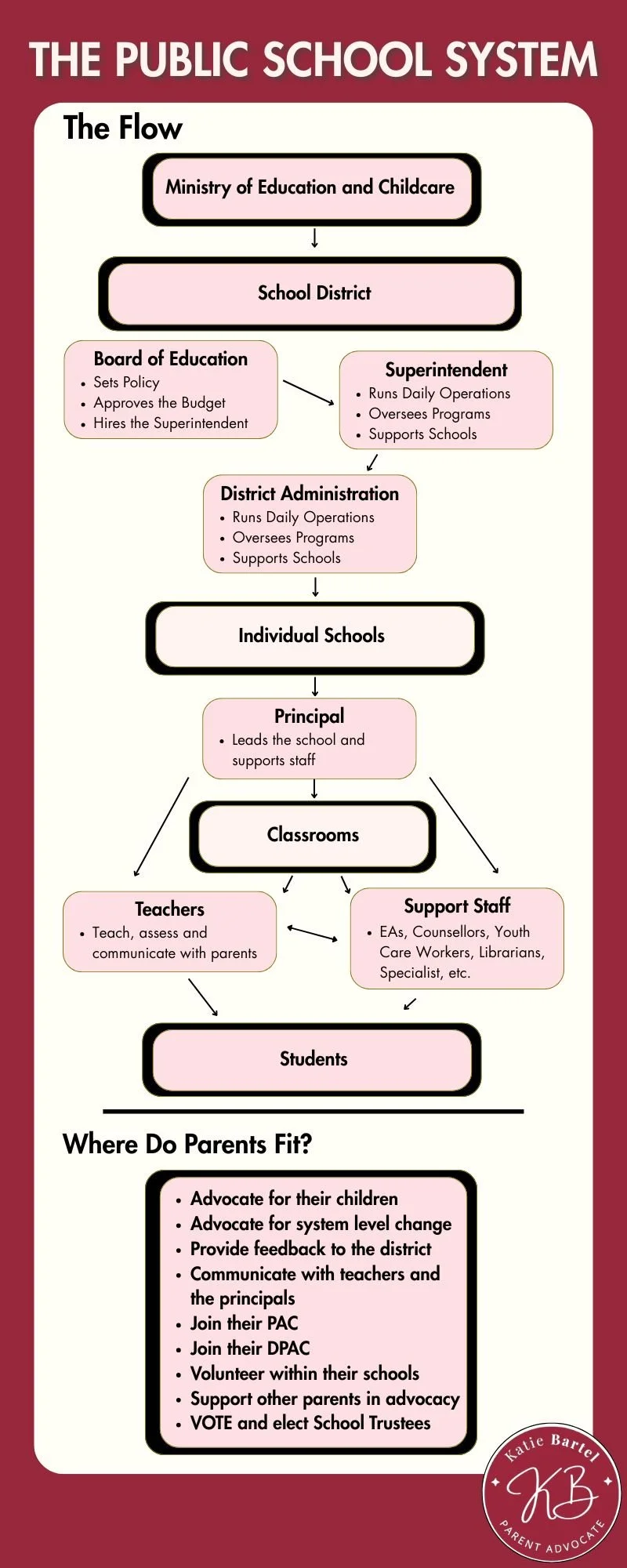
The Ministry: Sets the rules.
The District: Runs the system, interprets those rules.
Schools: Makes the rules real and implements them.
Classrooms: Where students experience the rules and the system.
Parents: Shapes priorities and holds the system accountable.
-
Who is accountable to who?
Ministry → District
Funding, policy, curriculum, reporting requirements
District → Schools
Staffing, resources, training, support staff, procedures.
Schools → Students & Families
Direct teaching and support.
Families → Schools → District → Trustees
Feedback, advocacy, concerns, community priorities.
District → Ministry
Compliance reports, student achievement data, audit requirements.
-
The system functions as a network, where each layer influences the others:
Classroom observations and assessments inform teacher recommendations.
Teachers communicate concerns to parents and administrators.
Administrators escalate significant issues to district staff or specialists.
District policies are directed by trustees and align with provincial standards set by the Ministry of Education and Childcare.
Every level needs the others to function well. When all parts work together effectively, students receive coordinated support, and parents can navigate the system with confidence.
When communication is strong and the relationships are collaborative, students thrive.
-
What they do:
Engaging in learning
Follow school rules
Communicating their needs when possible.
How they connect:
Students are the central focus of the system and the reason the public school system exists.
-
Parents are recognized by legislation in BC as essential partners.
What they do:
Advocate for their children
Participate in PACs and DPAC
Volunteer within the classroom and school
Work collaboratively with teachers and administrators
Give feedback on policies and practices
Vote and elect trustees
How do they connect:
While they don’t have any direct responsibility within the public education system beyond enrolling their student, their partnership is vital in supporting and advocating for the students’ education and holding the system accountable.
-
What they do:
Deliver instruction and curriculum
Assess student learning.
Identify learning needs and initiate support processes
Implement classroom strategies for students who need extra support.
Communicate progress and concerns to parents.
How they connect:
Teachers have significant autonomy over decisions in their classrooms, as long as they align with district policies and the provincial curriculum.
As the first point of contact for students, they play a pivotal role in shaping learning experiences, supporting growth, and influencing how the broader education system functions.
-
Support staff includes:
Educational Assistants (EAs)
Child & Youth Care Workers (CYCWs)
Learning Assistance Teachers (LAC/Resource)
Inclusion Teachers
Counsellors
Speech-language assistants
Library staff
Secretaries / office staff
Custodians
How they connect:
Each role has different responsibilities but they all support the school’s work to meet student academic, social-emotional, behavioural, and physical needs. -
This is the system that supports students with disabilities, diverse needs, or learning differences.
Typically includes:
District psychologists
SLPs/OTs/PTs
Behaviour consultants
Inclusive Education director
Mental health teams
Itinerant specialists (hearing/vision)
How they connect:
Referrals, assessments, program planning, and supports flow between the school team and district specialists.These teams help create IEPs, recommend strategies, support teachers and support staff and ensure legal obligations (like accessibility and inclusion) are met.
-
What they do:
Oversee the individual school operations and budget
Lead the school
Implement district policies
Manage staff
Coordinate supports
Handle safety, scheduling, discipline, and family concerns
Act as decision-makers when conflicts arise or escalated support is needed.
How they connect:
They are the bridge between families and the district. They interpret provincial/district rules within day-to-day school life. -
Led by the Superintendent. Roles typically include:
Superintendent: The CEO of the district; implements Board policy.
Assistant Superintendents: oversee schools and principals
Directors/Managers: inclusion, transportation, Indigenous education, facilities, HR, safety, technology, etc.
District specialists: psychologists, SLPs, OTs, learning support consultants, behaviour consultants
How they connect:
They run the operations of the district such as staffing, support services, programs, and decisions that impact multiple schools. As a team they allocate resources and provide guidance to schools on curriculum, staffing, and student services. -
They are municipally elected officials.
What they do:
Sets district-wide policies
Approves budgets
Hires and evaluates the Superintendent
Represents community values and culture.
Advocate for funding, infrastructure, and programs that affect all students.
Oversees long-term planning (capacity, new schools, strategic direction)
How they connect:
The Board answers to the public and guides the Superintendent. They do governance, not day-to-day operations. -
This is the Provincial top level of the system.
What they do:
Set curriculum and learning standards
Decide graduation requirements
Allocate funding to school districts
Create provincial policies and regulations
License teachers and approve programs
How it connects:
The Ministry creates the big-picture rules. Everything your school district and school does must align with provincial legislation and policy.